

Your heart pounds when someone raises their voice. You go quiet and blank in a hard conversation. You say yes to everyone, even when you are exhausted. These reactions can feel confusing or even embarrassing. Often, they are your body trying to keep you safe.
So, what is a trauma response? It is your nervous system’s automatic way of protecting you from danger. The four main types are fight, flight, freeze and fawn. They are not a choice or a character flaw. With time, practice and support, they can become less intense.
In this guide, you will find:
- What these reactions are and why they happen.
- What fight, flight, freeze and fawn look like in daily life.
- What can set them off, and how they feel in the body.
- Simple ways to calm your body in the moment.
- When it may help to talk with a therapist.
What Happens When Your Body Senses Danger?
Put simply, it is how your mind and body react to danger, or to something that only feels dangerous. It happens fast and without planning. Your nervous system acts first, and your thinking brain catches up later. The four main types are fight, flight, freeze and fawn.
These reactions are common after frightening or overwhelming events. The VA’s National Center for PTSD calls stress reactions “normal and not weakness.” It also notes that most people recover over time. For some people, though, the reactions keep showing up long after the danger has passed.
Why Does Your Body React Before You Can Think?
These reactions happen because your brain has a built-in alarm system. Its job is to spot threats and get you ready to survive them. When it senses danger, it floods your body with energy before you can think. After a scary experience, this alarm can become extra sensitive.
Your body may react as if the old danger is happening again. That is why a reaction can feel bigger than the moment in front of you. It is not overreacting on purpose. It is an alarm that has learned to ring early.
What Can Set Off These Reactions?
Reminders of a past event, often called triggers, can set off these reactions. A trigger might be a sound, a smell, a date or a feeling of being trapped. Triggers are not always obvious. Many people only notice the reaction, not what started it.
Common triggers include:
- A raised voice, a slammed door or a sudden loud noise
- A smell, song or place linked to a hard memory
- Certain dates, seasons or anniversaries
- Feeling criticized, ignored or trapped
- Crowded rooms or being touched without warning
- Body sensations, such as a racing heart after exercise
Noticing your own triggers takes time. A simple note on your phone can help. Write down what happened, what you felt and what your body did. Patterns often become clear after a few weeks.
What Are the 4 Types of Trauma Responses?
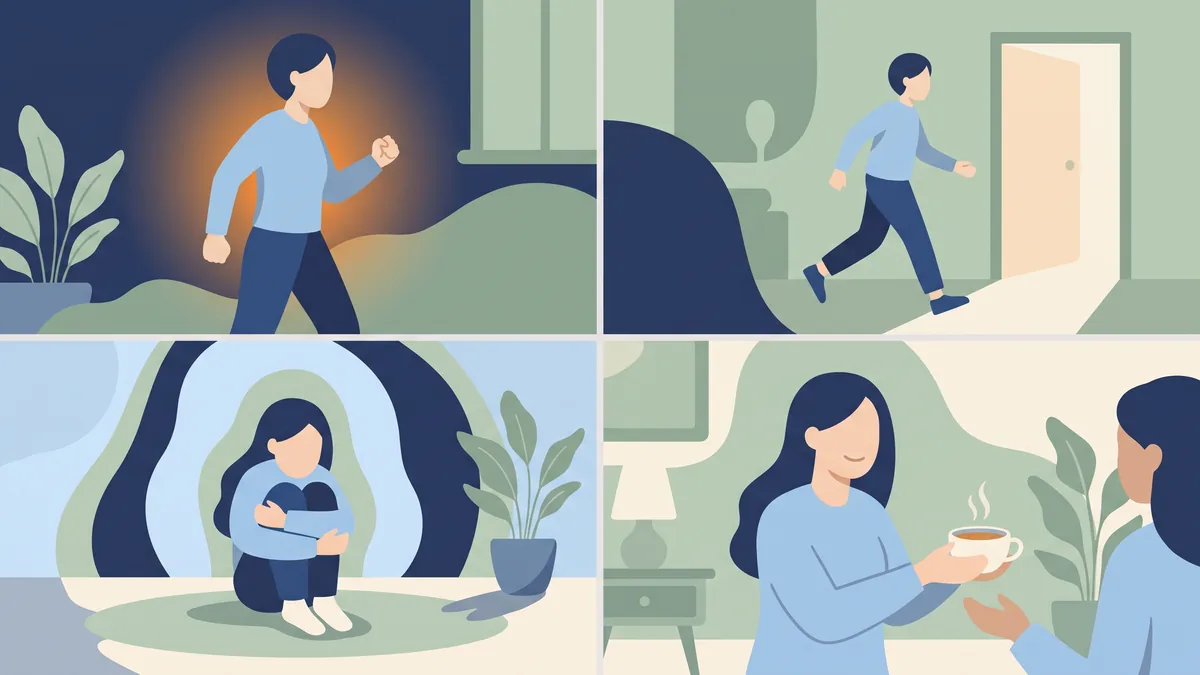
There are four main types: fight, flight, freeze and fawn. Fight faces the threat. Flight gets away from it. Freeze goes still. Fawn tries to keep others happy. Each one is a survival strategy, and most of us lean on one or two more than the others.
Fight
Fight pushes you to face the threat head on. It can look like irritability, arguing or a short temper. It can also look like a strong need to control things. Afterward, you may feel guilty about how sharp you were.
Day to day, fight might show up as:
- Snapping at loved ones over small things
- Feeling ready to argue when you feel criticized
- Gripping tight control over plans and details
Fight is trying to protect you by making you strong and ready. When it happens often, it can strain work and relationships. If anger feels hard to manage, our anger management counseling can help you understand what sits underneath it.
Flight
Flight urges you to get away. Sometimes that means leaving a room. More often, it looks like staying busy, overworking, worrying or avoiding hard topics.
Day to day, flight might show up as:
- Filling every hour so you never have to slow down
- Changing the subject when feelings come up
- Lying awake making plans and lists
Flight protects you by creating distance from what feels unsafe. The cost is that you rarely get to rest. Many people with a strong flight pattern feel restless even on quiet days.
Freeze
Freeze stops you in place. You might go blank, feel numb or find it hard to speak or move. Some people describe it as feeling far away from their own body.
Day to day, freeze might show up as:
- Staring at a task without being able to start it
- Going silent in an argument
- Feeling foggy, heavy or disconnected
Freeze protects you when fighting or running does not seem possible. Later, it can show up as feeling stuck, putting things off or shutting down during conflict.
Fawn
Fawn tries to stay safe by keeping others happy. It can look like people pleasing or agreeing just to avoid tension. You may struggle to say no. You may know other people’s needs better than your own.
Day to day, fawn might show up as:
- Apologizing even when you did nothing wrong
- Agreeing to plans you do not want
- Hiding your own opinions to keep the peace
Fawning often develops when keeping someone calm felt like the safest choice. Over time, it can leave you drained and unsure of what you want.
Trauma therapy
Do these patterns feel familiar?
You do not have to sort through them alone. Our therapists offer trauma therapy in person in Maplewood, NJ and online in six states. Your first step is a free 15-minute call.
Are There More Than Four Types?
Yes, some writers describe more than four. You may see “flop” or “collapse,” where the body goes limp or suddenly very tired. Others describe “tend and befriend,” which means reaching for connection and caring for others under stress. The four main types are still the ones most people use.
Lists of five or seven types vary from source to source. What matters most is noticing your own patterns, not finding the perfect label.
How Do These Reactions Feel in the Body?
In the body, it often feels like a racing heart, fast breathing, shakiness or sweating. The VA lists these among common physical reactions after trauma. Trouble sleeping and an upset stomach are common too. These reactions live in the body as much as the mind.
You may also notice:
- Tight shoulders, jaw or chest
- Feeling jumpy or easily startled
- Feeling numb, heavy or very tired
- Headaches when something reminds you of the event
These signals are your nervous system doing its job. Learning to notice them early is one of the first steps toward calming them.
Can You Have More Than One Response?
Yes. Most people move between responses depending on the situation. You might fight with a partner, fawn with a boss and freeze when a memory comes up. Most of us still have one or two default patterns. Noticing yours is a helpful first step.
To find your default, think back to a recent stressful moment. Ask yourself a few gentle questions:
- Did I want to argue, leave, go still or make the other person happy?
- What did my body do first?
- How did I feel an hour later?
There are no wrong answers here. The goal is awareness, not judgment.
Is This the Same as PTSD?
No. A stress reaction after a frightening event is common. Post-traumatic stress disorder (PTSD) is a condition that a licensed professional diagnoses. Many people have these reactions and feel better over time. Having them does not mean you have PTSD. A professional can help you tell them apart.
The National Institute of Mental Health notes that most people recover from early reactions. People whose symptoms continue may be diagnosed with PTSD.
Wondering whether past events still affect you? Our guide to signs of unresolved trauma can help you reflect.
How Do These Reactions Show Up During Conflict?
Conflict is one of the most common triggers. One partner may raise their voice while the other freezes or starts apologizing. Each person is reacting to feeling unsafe, yet both feel misunderstood. Naming what is happening and taking a short pause can help.
Some steps can help when this happens:
- Name what you notice, such as “I am starting to shut down.”
- Agree on a short pause, then come back to the talk.
- Speak about your own feelings instead of blaming.
If the same pattern keeps repeating, couples and family counseling can help both people feel safer with each other.
How Can You Help Someone Who Is Triggered?
To help someone who is triggered, stay calm and help them feel safe first. Logic rarely helps in the moment. Keep your voice low, give them space and offer simple choices. Save the talk about what happened for later, once they feel settled.
Try these steps:
- Keep your voice slow, low and calm.
- Give them space instead of crowding them.
- Offer simple choices, such as “Do you want to sit or walk?”
- Avoid saying “calm down” or “it is not a big deal.”
- Talk about what happened later, once they feel settled.
Taking care of yourself matters too. Supporting someone else can be tiring. Your own nervous system needs rest as well.
How Can You Calm Your Body in the Moment?
You can calm these reactions with simple grounding skills. Slow your breathing, notice what you can see and hear, and feel your feet on the floor. You cannot always stop a reaction from starting. You can learn to help your body settle sooner.

Try these five skills:
- Use the 5, 4, 3, 2, 1 method. Name five things you see, four you can touch and three you hear. Then name two you smell and one you taste.
- Slow your breathing. Breathe in gently. Then let the breath out a little longer than the breath in.
- Look around the room. Turn your head slowly and notice where you are. This reminds your body that you are here, now.
- Feel your feet on the floor. Press them down and notice the support under you.
- Name what is happening. Saying “this is my freeze response” can create a little space between you and the reaction.
These skills take practice. They often work best when you try them on calm days first. Try one skill for a minute each morning for a week. When a hard moment comes, your body will already know the steps.
Can These Patterns Change Over Time?
Yes. With time and support, many people find their reactions become less intense and pass more quickly. The goal is not to erase your survival instincts. The goal is to help your body learn when it is truly safe. Progress is often gradual.
Change usually comes in small steps. You might notice a trigger a few seconds sooner. You might calm down in ten minutes instead of an hour. You might pause before saying yes to a request you do not want. These small shifts add up over time. They are signs that your nervous system is learning something new.
Therapy can help with this. Our therapists use cognitive behavioral therapy (CBT) and Internal Family Systems (IFS). They also teach grounding, body-based skills and mindfulness. To learn how these work together, read what trauma therapy involves.
Book a session
Ready to talk with a trauma therapist?
Meet with us at our Maplewood office or by secure video in NJ, NY, PA, MD, TX or OR. We will listen and help you find the right fit.
When Should You Talk to a Trauma Therapist?
Consider talking to a trauma therapist when your reactions get in the way of daily life. That might mean your sleep, work, school or close relationships. The VA suggests talking with a counselor or doctor when reactions interfere with these parts of life.
Other signs it may help to talk with someone:
- You avoid places, people or activities you used to enjoy.
- You feel on edge most of the time.
- You are drinking or using more to cope.
- Your reactions feel stronger than the situation in front of you.
If you are in crisis or thinking about suicide, call or text 988. This reaches the 988 Suicide and Crisis Lifeline. In an emergency, call 911.
Where Can You Get Help in North Jersey or Online?
You can get help in person at our Maplewood office or online from home. Our office is at 1585 Springfield Ave, Suite 2, in North Jersey. We also see clients online in six states. Our team offers trauma therapy in Maplewood at a pace that feels safe for you.
Prefer to meet from home? We offer secure video sessions in New Jersey, New York, Pennsylvania, Maryland, Texas and Oregon. Online appointments are available into the evening.
You can meet our therapists, including Dr. Sheena Smith and Monica Rios, before you decide. The first step is a free 15-minute call. We will listen, answer your questions and help you choose what feels right.
Frequently Asked Questions
Is a trauma response a choice?
No. These reactions are automatic. Your nervous system reacts before you have time to think. You can, however, learn skills that help you notice them sooner and settle faster.
Is people pleasing a sign of fawning?
It can be. Constant people pleasing is often linked to the fawn pattern. It can develop when keeping others calm once felt like the safest option.
Can you get stuck in freeze mode?
Many people describe feeling stuck, numb or unable to start tasks for long stretches. Gentle movement and grounding skills can help. Support from a therapist can help the body slowly come out of freeze.
Do children react this way too?
Yes. Children can show fight, flight, freeze or fawn too. It may look like tantrums, clinginess, withdrawal or trying hard to please. Our child and teen therapy supports young people and their families.
What are the five F’s of trauma?
Some lists add a fifth F, called flop. Flop describes the body going limp or suddenly very tired. Lists vary from source to source. The four covered above, fight, flight, freeze and fawn, are the most widely used.
Is overreacting a sign of trauma?
Not always. Strong reactions can come from stress, tiredness and many other things. When a reaction feels much bigger than the moment, though, it may be an old alarm ringing. A therapist can help you sort out what is going on.
Can you be affected by trauma without having PTSD?
Yes. Many people have stress reactions after a hard event without having PTSD. These reactions can still affect sleep, mood and relationships. You do not need a diagnosis to ask for support.
Do you ever fully heal from trauma?
Healing looks different for each person. Many people find their reactions become milder and less frequent over time. Memories may remain, but they often feel less overwhelming. Support from a therapist can help this process along.
Can online therapy help with these reactions?
It can. Some people find it easier to open up from home. Our therapists offer secure video sessions in New Jersey, New York, Pennsylvania, Maryland, Texas and Oregon. You can practice grounding skills in the same space where you use them.
What Is Your Next Step?
Trauma responses are your body’s way of trying to protect you. Understanding them is a strong first step. You do not have to sort through them alone. If these patterns feel familiar, a short conversation can help you decide what support fits you.